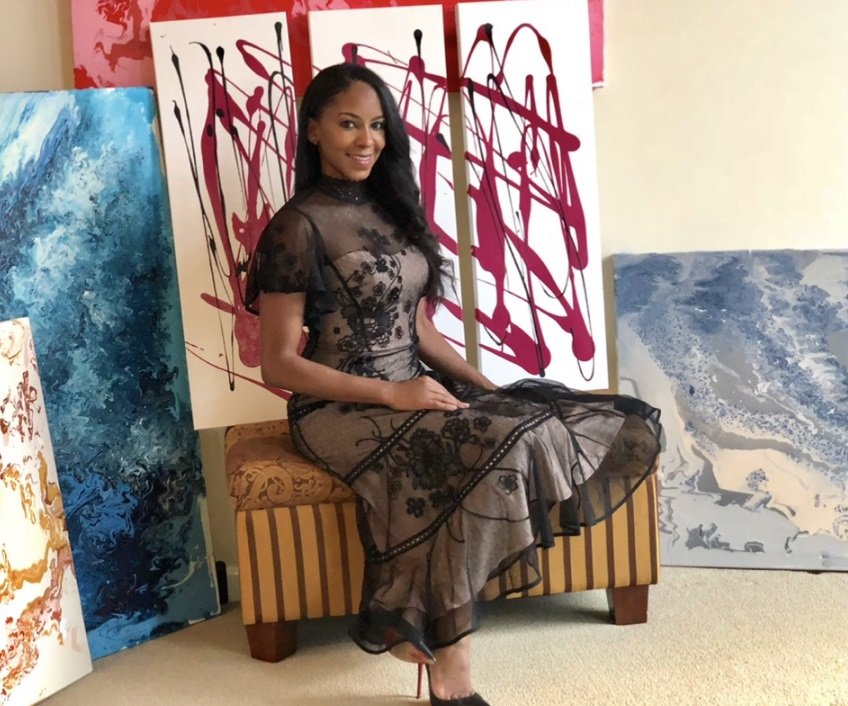
Sarah-Elizabeth is an Atlanta based contemporary abstract artist whose work explores power and emotional truth shaped by global movement and lived complexity.
Born and raised in Atlanta, Georgia, she is a graduate of Pace Academy, earned a degree in French Language and Literature from the University of Michigan, and holds a Juris Doctor from Howard University School of Law in Washington, D.C. Her multidisciplinary background spanning language, law, culture, and art grounds a practice that is both deeply personal and globally resonant.
Her practice has been profoundly influenced by time spent living and working across West Africa, Eastern Europe, and Asia, including formative periods in Côte d’Ivoire, St. Petersburg, Russia, Tokyo, Paris, Austria, Belgium, Switzerland, and Canada. These geographies, distinct in rhythm, restraint, ritual, and color, inform her layered compositions, which often hold tension between structure and release, formality and freedom.
Working primarily in abstraction, Sarah-Elizabeth creates emotionally driven works that emerge from heightened states such as joy, grief, reverence, and resolve, allowing intuition to guide composition while history and lived experience anchor meaning. Select works appear as diptychs and triptychs, a structural influence drawn from medieval religious altarpieces, reinterpreted through a contemporary lens to suggest continuity, devotion, and narrative unfolding.
Raised within the realities of American civic life and public leadership, her work is deeply informed by proximity to political power and its human cost. A recurring undercurrent in her art examines the negotiation between public composure and private truth, exploring how beauty, restraint, and diplomacy often coexist with urgency, sacrifice, and suppressed emotion.
Her work is held in private collections and has been commissioned for civic and community anchored spaces, including a series installed within a new Atlanta development adjacent to the city’s forthcoming FIFA World Cup site, and a permanent installation in a government center named in honor of her late father, a civil rights era public servant whose life and legacy continue to shape her understanding of courage, justice, and voice.